What Turkey got right in medical tourism — and how Greece can chart its own path
Turkey measures through USHAŞ — a state entity aggregating direct billing data from every JCI-accredited hospital that receives international patients. When a German or Arab patient undergoes surgery in Istanbul, the transaction is recorded directly as an “international health service.” Bottom-up. Precise.
Greece measures through the Bank of Greece’s Frontier Survey — the EU-standardized methodology that asks a sample of travelers at the border about their primary trip purpose and total expenditure, then extrapolates to total arrivals. Top-down, and entirely dependent on traveler self-reporting.
When a British patient travels to Athens for IVF and combines it with fifteen days in the Cyclades, she declares “leisure” at the border. The approximately €3,000–4,000 IVF fee disappears into Greece’s €23.6 billion general tourism figure — it never reaches the Bank of Greece’s health category.
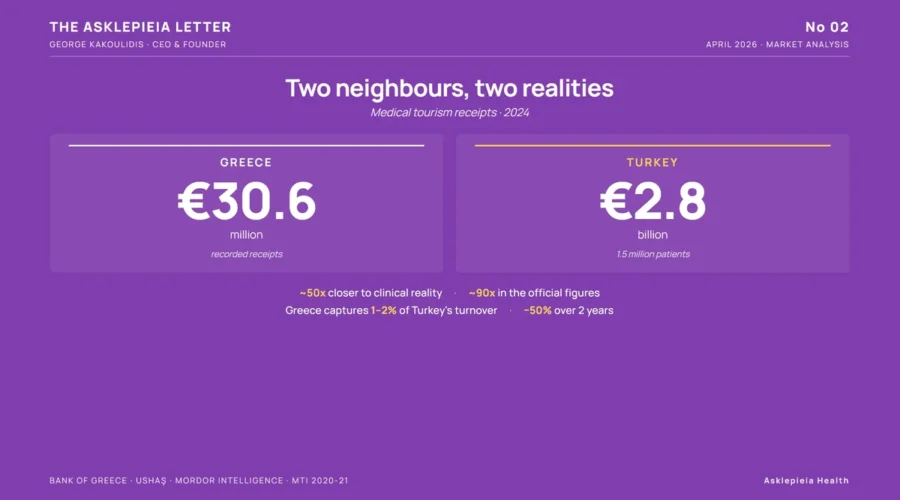
The actual clinical revenue of Greek medical tourism is a significant multiple of €30.6 million. The precise figure is unknown. Because no one is measuring it.
This is the first lesson from Turkey — before reaching the strategic ones: measure first, then coordinate, then win.
They Had No Advantage. They Built One.
- Turkey emerges from economic crisis and launches the Health Transformation Program — a comprehensive reform of its healthcare system.
- Purpose-built public city hospitals are created specifically to receive international patients.
- The Ministry of Health begins certifying providers for medical tourism, covering translation services and supporting international marketing.
- The International Medical Tourism Regulation enters into force — the legal framework that defines and protects the sector.
- USHAŞ is established — a state company dedicated exclusively to medical tourism. One entity, one strategy, one brand: Heal in Türkiye.
From 428,894 patients in 2015 to 1,506,442 in 2024. A 3.5x increase in nine years.
When Turkey was building USHAŞ, Greece had — and still has — a diverse institutional landscape: state bodies, professional associations, private clinics, world-class hotels. Without central coordination. Without central measurement.
The Four Things Turkey Did Right
1. State coordination with measurable performance. USHAŞ is not a ministry. It is not an NGO. It is a state company functioning as a manager — coordinating public and private sectors, setting standards, promoting a single brand, and counting every patient and every euro.
2. Financial incentives. VAT exemption on services to foreign patients. Partial corporate tax exemption on medical tourism revenues. 50% subsidy on international marketing expenditure, up to approximately €46,000 per program. 60% support on patient flight costs. Coordinated. Guaranteed. Recorded.
3. Volume strategy with competitive pricing. Focus on specialties where volume wins: aesthetic surgery (38.5% of the Turkish market), hair transplants, dentistry. Prices 50–80% below Western Europe and the United States. A bypass procedure that costs approximately €110,000 in the US costs approximately €13,000 in Turkey.
4. Aggressive international marketing. 46 JCI-accredited hospitals (top three globally), the state brand Heal in Türkiye, Turkish Airlines partnerships, and digital campaigns targeting the UK, Germany, Arab countries, and Russia. Turkey does not wait for patients. It goes looking for them.
Mordor Intelligence projection: approximately €8.7 billion by 2031.
Greece Does Not Need to Become Turkey. It Should Not.
Turkey won on volume and price. For Greece, that would be the wrong strategy — not because it is unachievable, but because there is a different market to win. Independent quality indices confirm this.
In the Medical Tourism Index published by the International Healthcare Research Center, Greece ranks above Turkey (35th globally) on the Destination Environment index — safety, culture, travel experience. These are precisely the criteria that matter to international patients choosing a destination on the basis of EU regulatory framework, security, and quality of life during recovery.
Additional indicators: #25 on the FREOPP World Index of Healthcare Innovation 2024, a high score on the Healthcare Access and Quality Index (Lancet/IHME), 6.58 physicians per 1,000 inhabitants — among the highest ratios in the EU (OECD 2023) — and approximately 270 public and private hospitals.
Greece also holds assets Turkey cannot easily replicate: EU regulatory framework, a progressive IVF legislative environment, the Mediterranean diet with global recognition, and the ancient Greek identity of healing — the Asclepieia, Hippocrates, a historical legacy that belongs to no other country.
This does not mean Greece wins at Turkey’s expense. It means Greece can win alongside Turkey.
Why Turkey Is Not a Competitor — and Why the Region Wins Together
Turkey is the most successful regional medical tourism story in the neighborhood. It has built something substantial over two decades. It has scale, logistics, and an international network.
Greece brings different assets: EU framework, quality of life for recovery, and the ancient Greek identity of healing.
Two distinct propositions for different patients — with the potential for shared routes rather than opposition. Synergies in patient journeys, joint airline and hotel partnerships, overlap in Middle Eastern and North African markets. A Mediterranean health region that wins more together than it would separately.
What Greece Actually Lacks
It is not quality. It is not talent. It is coordination — and the ability to measure what is being done.
Turkey built USHAŞ not only to coordinate but to record. USHAŞ knows which foreign patient entered which hospital, for which procedure, at what cost. Greece has no equivalent infrastructure.
The consequence is specific: it is impossible to demonstrate to investors, foreign patients, or the state itself that the market exists at a scale worth a national strategy. The Bank of Greece sees €30.6 million. The actual revenue flowing through Greek clinics is a significant multiple of that figure. Without unified measurement, it remains invisible.
What This Means in Practice
Waiting for the state to build a Greek USHAŞ is not the plan. Perhaps one day. Almost certainly not soon.
In the meantime, the work proceeds with what exists. Asklepieia today connects over 290 healthcare providers and 64 hotels in a unified ecosystem — organized, for the first time in Greece, under a single structure. On this foundation, it becomes possible to begin measuring what is missing at the national level.
This is not a government initiative. It is not the definitive solution. It is the beginning of a private coordinator — and a counter — for a sector that can no longer wait for the solution to come from above.
The Question That Remains
Turkey did not have better quality of care. It did not have a better Destination Environment. It did not have an ancient healing tradition or an EU regulatory premium.
It had a state entity that measures and coordinates.
Greece has everything else. That one piece is missing.
What would it take for Greece to build its own equivalent — and who needs to make the first move?
Sources: Bank of Greece — Developments in the Balance of Travel Services 2024 (€30.6M health-purpose receipts) · USHAŞ — Turkish state medical tourism agency 2024 (~€2.8B / USD 3.022B official / 1,506,442 patients) · Medical Tourism Index 2020-21 (International Healthcare Research Center) · FREOPP World Index of Healthcare Innovation 2024 · Healthcare Access and Quality Index (Lancet/IHME) · Mordor Intelligence — Turkey Medical Tourism Market 2031 projection · OECD Greece Country Health Profile 2023.
George Kakoulidis, CEO & Founder, Asklepieia Health Cluster
This article is for informational purposes only and does not constitute medical advice. Treatment options, clinical outcomes, costs, eligibility, and legal or regulatory requirements may vary by individual circumstance and by jurisdiction. Always consult a qualified physician — and, where relevant, a qualified legal advisor — before making decisions about diagnosis, treatment, or care arrangements.