
From exemption to 24%: how hospitalisation in private clinics came to be taxed
Issue 07, THE ASKLEPIEIA LETTER, September 2026. Barrier 2 of the seven barriers to health tourism.
Previous issues: Issue 05, “Seven Barriers to Health Tourism in Greece”, with the seven barriers. Issue 06, “The Registry Doesn’t Bring Patients”, with barriers 1, 3 and 5.
Take a patient undergoing rehabilitation after a stroke.
If they go to the centre in the morning and return home, their care carries no VAT.
If they are admitted for overnight inpatient care at the same private centre, the hospitalisation fee carries 24%.
Same patient. Same centre. The treatment may be the same. With the overnight stay, however, it falls under hospitalisation. And its tax treatment changes.
Now take a minor therapeutic procedure under local anaesthesia, without an overnight stay. In a stand-alone private Day Care Unit (DCU), that is, a unit operating under a DCU licence and not as a clinic, and performing procedures only under local anaesthesia, the procedure carries no VAT, even if the unit is for-profit. The law places these units within primary health care. If the same procedure, by the same doctor, is performed in the DCU that operates as a department of a private clinic, the clinic’s bill carries 24%.
This is not an error. It is the system, as it came to be.
The full study, with a source and a level of certainty for every claim, is available in Greek: Read the full study (PDF in Greek, 38 pages).
Where I write “private clinic” or “private rehabilitation centre”, I mean those operating for profit. Hospitalisation in non-profit ones that meet the conditions of the law is exempt from VAT. I also compare the general rates. Special reductions apply on certain islands, under the conditions of the VAT Code.
First, a correction
It is often said that “Greece taxes health at 24%”. That is inaccurate.
The VAT Code exempts medical care provided in the exercise of the medical professions, and it also names, among others, physiotherapists, speech therapists and occupational therapists. This provision sets no condition on whether the provider seeks profit. Purely aesthetic procedures with no therapeutic purpose remain outside.
What is taxed in our examples is the hospital care of the private clinic or the private rehabilitation centre. And it is not just the bed. It is also the operating theatre, the materials, the medicines and the food that accompany the hospital stay. The surgeon issues a receipt without VAT. The clinic’s receipt carries 24%, even if the patient leaves the same day.
A different provision applies to the clinic. Bodies governed by public law are exempt, and private providers only if they meet three conditions together. The first is that they do not systematically seek profit and do not distribute their profits. A private clinic that pays a dividend to its shareholders does not meet even the first condition.
This is lawful. The EU VAT Directive expressly allows Member States to set this condition, and Greece set it. I am not claiming that anyone broke the law.
What Europe allows
The Directive has its own Annex III, listing what may carry reduced VAT, subject to specific derogations. It is a menu, not a prescription: each state decides which items it will apply.
Point 17 contains, verbatim, “the supply of medical and dental care and thermal treatment in so far as those services are not exempt pursuant to points (b) to (e) of Article 132(1)”.
The last phrase is easily read backwards. It does not say that medical services carry no VAT. It says that those already free of VAT, such as the doctor and the public hospital, come off the list. What remains are those that pay VAT, such as the private clinic’s service. These are exactly the ones Europe allows to be placed under a reduced rate.
And Greece already does it. Since February 2020, specific radiotherapy procedures that are not exempt, such as in a private clinic, carry 6%. It is not a general reduction for the rest of the same patient’s hospital stay. Until then they paid 24%. The Ministry of Finance itself says so in the explanatory report of the provision.
Someone will object that point 17 speaks of “medical services”, not of hospitalisation with accommodation and meals. The Greek state has already read it differently. In 2010, the explanatory report of the law noted that “medical services which do not fall under the said exemption provision will be subject to the reduced rate”. In 2015, the tax administration’s circular gave, as an example of medical services that moved to 23%, the services of private clinics to inpatients. It is the interpretation of the Greek administration, not a ruling of a European court. That is why the final wording must undergo legislative-drafting review on this point.
The Directive’s general rule allows up to two reduced rates, not below 5%, for a limited number of categories. On our reading, neither limit stands in the way of the request: no new rate is being requested, and radiotherapy shows that Greece already uses the category of medical services.
The main question is not whether it is allowed. On the reading that the Greek administration itself applied until 2015, it is allowed, and we already do it for radiotherapy. The question is why we do not extend it to hospitalisation.
How we got to 24%
In 2010 Law 3842/2010 restricted the exemption for hospital care to public and non-profit providers. The purpose, according to the explanatory report, was “the strengthening of public health organisations, as well as of organisations that provide these services on a non-profit basis”. Private providers, however, were placed under a reduced rate: 11% from 1 July 2010, when the change took effect, and 13% from 1 January 2011.
Ιn July 2015 Law 4334/2015 replaced the entire Annex III of the Greek VAT Code. The entry for medical services was not carried over, and those that were not exempt moved to the standard rate, then 23%. In the circular that implemented the law, they appeared on the same list as catering and care homes for the elderly. Of the laws and circulars we checked on the 2015 change, private clinics were named only in that circular, and only as an example. This describes the way the legislation was made. It does not prove that a policy purpose was absent.
In 2016 the standard rate rose to 24% for the whole economy.
The difference justified in 2010 was exemption versus a reduced rate, not versus the standard rate. In the texts on the 2015 change that we examined, we did not find any specific assessment of patient access or of the sector’s international competitiveness.
Other categories that found themselves exposed that same summer were restored. For recognised private educational institutions, the exemption was restored within the same year, retroactively. Care homes for the elderly returned to a reduced rate in 2018. Catering returned in 2019.
These are not the same cases as the clinics: education returned to exemption, and the provision on care homes for the elderly expressly concerns social welfare. I invoke the method, not the similarity.
The result today: the covered, non-exempt service of the private care home for the elderly carries 13%. Inpatient care at the private rehabilitation centre carries 24%.
The sector has asked for it
According to a press report of the time, the Association of Greek Clinics wrote to the ministers in June 2015, before the standard rate was imposed, asking that VAT not be raised. In April 2024, the Association of Private Clinics of Greece, a different body, requested in writing “the de-escalation of the VAT rate to 6% for all clients of private clinics”.
In January 2020, according to press reports, the reduction was seriously discussed. According to a senior official who spoke to healthreport.gr, the Ministry of Finance would accept it only if it were fiscally neutral. According to the same report, the Ministry also set a second condition: that the creditors agree. The second condition has changed form: the country’s enhanced surveillance ended in August 2022, but the monitoring of public finances continues. In February 2020, one month after that discussion, by an amendment from the same Ministry, 6% was enacted for a single health service, radiotherapy. For hospitalisation, we did not find a public text explaining why the discussion did not reach a conclusion.
The inequality between the clinic and the stand-alone DCU is not our discovery. An association of private clinics had already raised it in writing with the ministers in July 2015. In the sector texts we located from 2015 to today, we found no reference to point 17 of the Directive. This does not mean that the bodies did not examine it. It means we did not find it in their public texts. If the argument exists somewhere and we missed it, I would very much like to see it. It is stronger if the sector submits it than if I do.
Who pays the 24%
On the bill, the VAT does not stay with the clinic: it is paid by whoever pays for the hospital stay. With the clawback (automatic refund), the picture changes, as I explain below.
EOPYY (the National Organisation for the Provision of Health Services). For the hospital care it covers, it pays the largest part of the bill. Its expenditure ceilings include VAT.
The EOPYY-insured patient. Under the EOPYY Benefits Regulation, they contribute, as a rule, 30% for hospitalisation under a closed consolidated hospitalisation fee (KEN) and 10% for hospitalisation under a daily fee at a contracted private clinic. EOPYY training material gives a real hospitalisation case under a KEN. It is a specific reimbursement case, but it shows how the tax comes in. The KEN component comes, with 24% VAT, to €1,524.46, and the insured patient pays 30%, about €457, of which about €88.5 is VAT. At a 6% rate, and if the price and the contribution stayed the same, they would pay about €391, that is €66 less. Their total contribution for the case is higher, €498.33, because it also includes two days of extended stay.
The family of the patient in rehabilitation. What EOPYY covers is not the whole cost. A rehabilitation centre informs patients on its website that EOPYY’s special daily fee is supplemented by a room “upgrade”, even for a three-bed room. According to the contract terms reported in a 2018 news story, the EOPYY fee corresponds to a four-bed room, while the centres’ specifications since 2005 provide for rooms of one to three beds. In July 2025, EOPYY began negotiating new contracts with the centres. We did not check whether this term has changed.
If the term still applies, the cause of the room-class difference is the gap between the fee and the specifications, not a choice by the family, and EOPYY does not cover it. The family pays it, unless they have private insurance that covers it. On our reading, the difference follows the hospital stay, so it too carries 24%. If a family pays, in a hypothetical example, €60 a day for a two-bed room, €11.6 of that is VAT. At 6%, and if the reduction were passed on to the price, they would pay about €51.3, that is about €390 less over 45 days of hospitalisation.
The privately insured patient. The insurance company pays for the hospital stay together with the VAT, which for it is a cost, because it cannot offset it, as the Hellenic Competition Commission notes in its sector inquiry into private health services (August 2025). By its estimate, if the effect of VAT is approximately removed, the increase in the average claim cost from 2011 to 2023 is 41.5% instead of 55.3%. By our own calculation, the ratio of the two percentages corresponds to the rise in the rate from 13% to 24%: 1.553 to 1.415 is roughly the same as 1.24 to 1.13.
The foreign patient. When hospitalised as a private patient at a Greek private clinic, they pay the same rate. The fact that they come from abroad is not enough for an exemption.
But let us be honest: health tourism is the reason the subject entered this series, not the main recipient of the measure. EOPYY’s expenditure ceilings for private clinics and rehabilitation centres alone exceed €450 million in 2026. There, the reduction passes through to the insured patients’ contribution, where that is calculated on a fixed net price, as with the KEN, and to the room-class difference only if it is passed on to the price. So that EOPYY’s part does not stay with the provider, the ceilings must be adjusted, as we propose below. For foreign patients we did not find corresponding data.
One caveat must be stated. At free prices, for private patients, insurers and foreign patients, it is not guaranteed that the whole reduction will reach whoever pays the bill. It is something that can be measured, if the data requested in the second request are published.
What should be requested
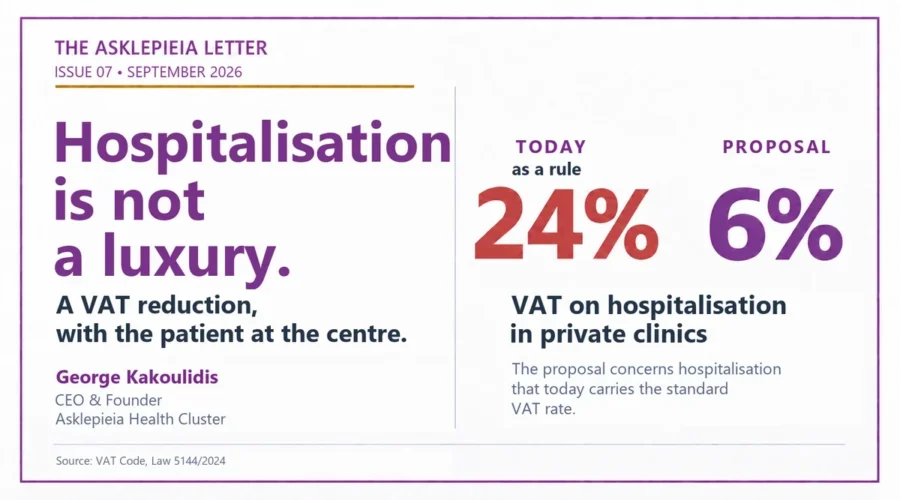
First. Hospitalisation in a private clinic and in a rehabilitation centre, and day surgery within the clinic, to go from 24% to 6%. Legally, this means restoring to Chapter B of Annex III of the VAT Code the entry for medical services that are not exempt, as it existed until July 2015, at a rate of 6%. Whatever carries no VAT today stays VAT-free. The difference from the patient who returns home or from the stand-alone DCU does not disappear. It shrinks from 24 to 6 percentage points. Procedures of an exclusively cosmetic or aesthetic nature are not included in the 6%.
Why 6% and not zero? The difference shrinks, but it does not disappear. Under the Directive’s general rule, a rate below 5% is not permitted for the medical services of point 17. Greece already has the two reduced rates of the general rule, 13% and 6%, and cannot add a third. It also has 4%, for works to remove architectural barriers, but the Directive allows a rate below 5% only for certain points of Annex III, and point 17 is not among them. The 5% option would require restructuring the existing reduced rates, not simply adding one more. Exemption is a different route: for non-public bodies it presupposes comparable social conditions and recognition by the state, and as a rule it gives no right to deduct the VAT on purchases. For a clinic or centre with large investments, 6% may be better. For the State the opposite may hold, and the costing must measure it.
Why 6% and not 13%, which applied until 2015? Because Greece has already chosen 6% for one medical service, radiotherapy, “for reasons of social welfare”. Inpatient rehabilitation after a stroke is no less a social matter. The request therefore goes lower than the pre-2015 regime, and we say so openly.
Second. The VAT paid on hospitalisation to be published, at aggregate level and not per provider, separately for EOPYY’s payment, the insured patient’s contribution, the insurer’s payment and the patient’s direct payment. The patient’s origin from abroad to be recorded as a separate dimension.
The cost to the State
Remember the first condition of 2020, fiscal neutrality. For radiotherapy, the Ministry of Finance itself wrote that the reduction to 6% is made “without a notable fiscal impact”, because EOPYY covers the greater part of the cost of radiotherapy for cancer patients.
For hospitalisation the answer is not self-evident, and we must say so. In the part that EOPYY pays, the tax goes round in a circle: it leaves a public fund and returns to a public fund. But there is a trap. EOPYY’s expenditure ceilings are a closed budget, and when providers exceed them, the excess is returned through the clawback (automatic refund). If VAT is reduced and the ceilings stay the same, while expenditure remains above the ceiling, EOPYY will pay the same, the State will collect less VAT, and the provider will keep the difference. The trap is absent only where expenditure is already below the ceiling: there, EOPYY automatically pays less. Where it exceeds the ceiling today, the provider keeps part of the reduction even if the new expenditure falls below the ceiling, and all of it if the excess exceeds roughly 17%.
The solution is to adjust the expenditure ceilings to the new rate. Then, in the part that EOPYY pays, EOPYY pays less by exactly as much as the State collects less, and the provider keeps the same net revenue. In that part, the reduction can be designed so as not to burden public finances. This is our own proposal, not the position of any body.
The insured patient’s smaller contribution, however, does not belong to that part. It is VAT that the State stops collecting. In the KEN component of EOPYY’s example, the VAT falls by about €221: with adjusted ceilings, about €155 is saved by EOPYY, and the €66 stays with the insured patient, as lost revenue for the State. There is also a direct loss of revenue on whatever is paid privately, if net prices and the volume of services stay constant. The arrangement will also need a transitional provision for the rebates (mandatory discounts) and the clawbacks of months invoiced at 24%.
We do not claim that the measure is neutral overall. We ask that it be costed openly: first the data, then the costing, then the decision. That is why the second request exists.
Greece’s choice to exempt hospitalisation only when it is provided by public bodies or by non-profit bodies that meet the conditions of the law is lawful. The Directive, however, allows it; it does not impose it. Other states chose differently: Cyprus and Spain exempt, on their own terms, hospitalisation in private hospitals too. So does the United Kingdom, with a rule written while it was a member of the Union.
I am not asking for an exemption. I am asking for the 24% rate on hospitalisation to be reconsidered, with data about the patient, not only about the budget.
The full study, with the proposed wording of the provision, the detailed history and the evidence table, is available in Greek: Read the full study (PDF in Greek, 38 pages).
In the next issue: cross-border insurance and bilateral agreements.
If you have experience of the subject, whether in tax, insurance or European matters, or if something here is wrong, I would very much like to hear it.
Key sources: VAT Code (AADE) · Directive 2006/112/EC · Explanatory report of 2010 (Hellenic Parliament) · POL. 1160/2015 · Law 4664/2020, Article 10 (radiotherapy) · EOPYY expenditure ceilings 2026 · Hellenic Competition Commission, health sector inquiry (2025) · POL. 1178/2018 (Day Care Units) · Law 5243/2025, Article 92 (stand-alone DCUs) · Explanatory report of the 2020 amendment · EOPYY Benefits Regulation 2025 · EOPYY training material, p. 12. All sources, with a level of certainty for every claim, are in the Annex of the study.
Where we write “we did not find”, we searched aade.gr, hellenicparliament.gr, opengov.gr, e-nomothesia.gr, taxheaven.gr, the websites of the sector bodies and 15 Greek news outlets. The absence of a finding does not prove that something does not exist.