
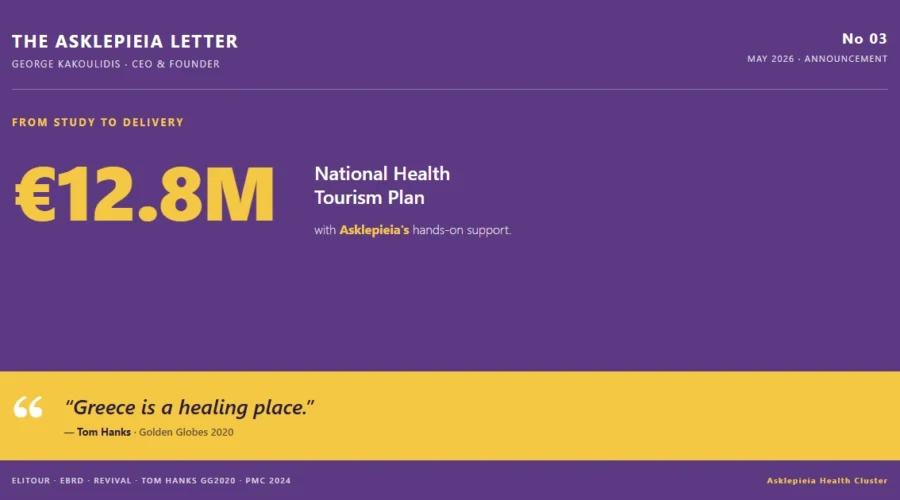
From study to delivery: the €12.8 million National Health Tourism Plan
For years, Greek healthcare has shared an open secret: the country has the talent, the climate, the natural assets, and the cultural heritage to lead in medical tourism Greece — yet it has acted like a system waiting for patients to arrive rather than one designed to bring them in. That posture is shifting. A national strategic plan is now funded and published, a Greek-led cluster is operationalising what the plan recommends, and a new digital platform is connecting providers, hotels, and patients in real time. This article walks through what changed in late 2025, what is being built now, and how to participate.
From Diagnosis to Response
In an earlier piece in this series, we identified the structural mistake nobody in Greek healthcare wanted to admit: thinking like a system that waits for patients rather than one that brings them in. A follow-up looked at what Turkey did differently — four strategic moves, an organised measurement system, national co-ordination — and how the gap widened. Today’s piece is about response. The diagnosis is on the record; the question now is execution. Two announcements from late 2025 give that execution real, public substance: a costed national plan and a working private-sector cluster moving in the same direction.
Two Announcements Now in Motion
On 5 December 2025, the Greek Health Tourism Council (ELITOUR) presented the National Significance Study on Health and Wellness Tourism, funded by the European Bank for Reconstruction and Development and authored with scientific support from Revival Consulting Services S.A. The plan it underpins is a €12.8 million, three-year roadmap for health tourism Greece, addressing regulatory frameworks, infrastructure, staff training, and digital upskilling.
ELITOUR President Dr George Patoulis described the study as a milestone for Greek health and wellness tourism. George Kakoulidis, CEO of Asklepieia Health Cluster and a member of the ELITOUR Board, contributed to the design of the study and to securing EBRD funding.
Today we move from contribution to execution. The cluster has begun implementing specific actions aligned with the plan’s axes — not as a state initiative or an official executor, but as a private collaborative formation operating alongside it. The focus is concrete service development in the geographies and themes the plan identifies, with measurable milestones and public accountability.
The second announcement is platform-side. The new Asklepieia platform, live since December 2025, is preparing a significant release that brings deeper integration with existing provider systems (EHR, booking, CRM); personalised care navigation by need and real-time provider availability with direct booking across the network; and the horizontal use of advanced AI for patient–provider matching, intelligent support, and operational efficiency across the cluster.
Network Snapshot (As of May 2026)
The figures below are drawn from the cluster’s own operating records. They describe the network as it is wired today, not as it is marketed.
| Element | Current state |
|---|---|
| Healthcare providers | 290+ contracted clinics, doctors, and care centres |
| Hospitality partners | 64 partner hotels |
| Services available | 700+ health and wellness services |
| Languages | Greek and English (further languages on the roadmap) |
| Operating mode | Patient names, booked appointments, follow-ups, answerable contact channels |
This is not a directory of paid placements. It is a working network with patient identities, booked appointments, follow-up windows, and a telephone line that is answered. The architecture is built for the present decade: data interoperability, real-time communication, and accountability when something does not go as planned.
A Cluster Opens: A Formal Invitation
The word “cluster” in the name is deliberate. A cluster is a collaborative formation — not a start-up, not a state body, not a directory of paid listings. As of today, the cluster is opening a formal invitation to collaborate across four constituencies.
- Healthcare providers — clinics, medical practices, and diagnostic centres that want patient flow that works and a network that supports it.
- Hospitality partners — boutique, wellness, and chain hotels that want health-aligned positioning, revenue diversification in the low season, and structured connections with healthcare partners.
- Public-sector bodies — university hospitals, EOPYY, and local authorities seeking a working bridge to the private sector without bureaucratic friction.
- International partners — medical tourism agencies, insurers, and international employers placing Greece on the map as a credible healing destination.
Asklepieia operates as a facilitator and marketplace operator, not as a direct medical provider. Every clinic, hotel, and diagnostic centre named in the network is independently licensed and accountable for the clinical or commercial decisions within its own scope.
If you are a helatprovider, hotel, or potential partner thinking about whether the Asklepieia Health Cluster is the right fit, the next step is a short conversation. You can browse the current services directory or view the hospitality partners already in the network before getting in touch.
From 300 Asclepieia to a Modern Network
Twenty-five centuries ago, more than 300 Asclepieia operated across the ancient Greek and Roman world — a peer-reviewed history describes them as a “sacred healthcare network” with shared architecture, a shared training lineage of Asclepiadae, and a shared clinical practice. Hippocrates taught within this network on the island of Kos. The most complete surviving sanctuary, at Epidaurus, has been inscribed by UNESCO as a World Heritage site since 1988.
Tom Hanks said it publicly in this generation, on receiving the 2020 Cecil B. DeMille Award: “The land, the sky, the water, it’s good for the soul; it’s a healing place.” The history had already documented the point. We did not invent anything. We are continuing something that has existed for 2,500 years — with the tools of the 21st century.
Frequently Asked Questions
What is the Asklepieia Health Cluster?
It is a Greek medical tourism network and marketplace facilitator that connects licensed healthcare providers, hospitality partners, and international patients. It is not a hospital or clinic and does not deliver clinical care directly; each provider in the network is independently licensed.
How does the cluster relate to the ELITOUR national plan?
Asklepieia operates as a private collaborative formation that develops services in the geographies and themes the ELITOUR national plan identifies. It is not a state initiative or an official executor of the plan; it operates alongside the plan.
What does the upcoming platform release add for patients?
Personalised care navigation by need, real-time provider availability with direct booking across the network, and AI-supported matching between patients and providers — together with deeper integration into provider systems (EHR, booking, CRM) for continuity of care.
How can a provider, hotel, or international partner join?
Healthcare providers, hospitality partners, and international agencies can express interest through the website. Each onboarding follows the cluster’s standard contract and verification process; participation does not require ELITOUR or EBRD affiliation.
Conclusion
Greece has the underlying assets to play a serious role in medical tourism Greece — climate, talent, cultural heritage, and now a costed national strategic plan. What had been missing was a private-sector formation able to move at the speed of execution while staying aligned with the public plan’s axes. The cluster model is that formation. The network is in place, the platform is being upgraded, and the invitation to collaborate is open. The next twelve months will show how much of this is conversation and how much is delivery — measurable milestones, in public. The conversation starts with a short call.
Sources: Tom Hanks press conference, Golden Globes 2020 (Cecil B. DeMille Award), January 2020 · ELITOUR — “Health and Wellness Tourism in Greece: Trends, Prospects and Challenges — A Research Analysis of the Greek Market” (2025, with EBRD support, drafted by Revival Consulting Services S.A.) · Historical evidence on Asclepieia: peer-reviewed “Asclepieia in ancient Greece” (PMC/PubMed, 2024) · UNESCO World Heritage — Sanctuary of Asklepios at Epidaurus · Asklepieia Health Cluster verified network data (May 2026).
George Kakoulidis — CEO & Founder, Asklepieia Health Cluster · Founder & President of ESPY (Hellenic Society of Health Informatics) · Co-founder, HL7 Hellas · Co-founder, Open Health Alliance (the first innovative medical network in Greece).
This article is for informational purposes only and does not constitute medical advice. Treatment options, clinical outcomes, costs, eligibility, and legal or regulatory requirements may vary by individual circumstance and by jurisdiction. Always consult a qualified physician — and, where relevant, a qualified legal advisor — before making decisions about diagnosis, treatment, or care arrangements.


