
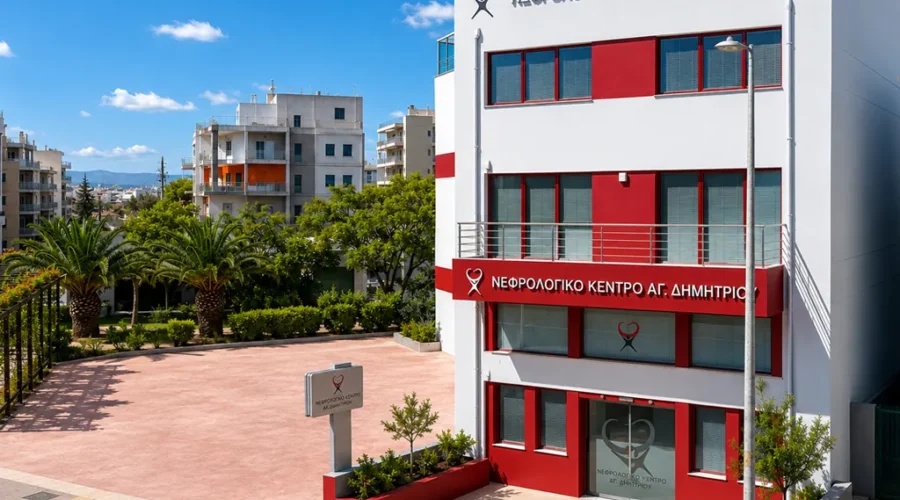
Inside NEKAD Dialysis Center in Athens
A dialysis unit is judged less by its reception area than by details most visitors never notice: how many machines are on the floor, whether a nephrologist actually directs care, and what happens the day a new patient’s blood test comes back unclear. NEKAD Dialysis Center, a chronic hemodialysis unit in Ag. Dimitrios, Athens, has joined the Asklepieia Health marketplace as a Verified Listing. This piece looks at those working details rather than the waiting room, and explains how to reach the centre through Asklepieia once you have them.
Scale and Infection Control, Not Just Machines
The centre’s Asklepieia profile lists 30 B. Braun hemodialysis machines, with two machines reserved exclusively for seropositive patients. That separation is not a marketing detail — it reflects a documented clinical practice. A clinical practice guideline on managing bloodborne viruses within the haemodialysis unit, published in BMC Nephrology, sets out why hepatitis B–positive patients require a dedicated, isolated machine rather than shared equipment: it prevents cross-contamination between patients on a unit where blood is filtered externally multiple times a week. For patients comparing dialysis and care centres on the Asklepieia marketplace, whether a unit separates its equipment this way is a reasonable, concrete question to ask before committing.
Beyond the dedicated machines, the profile describes a reverse-osmosis water processing system feeding the unit, Swiss-manufactured low- and high-flow filters, and on-site emergency haematologic and microbiological testing — the kind of capability that shortens the wait when a session throws up an unexpected result.
Specialist-Led Care and Professional Registration
According to its Asklepieia profile, NEKAD’s scientific direction is overseen by a named nephrologist, Dr Christoforos Papadopoulos, and the centre states it is registered with the Hellenic Society of Nephrology, Greece’s professional body for the specialty. A named clinical director and a stated professional registration are the kind of concrete, checkable facts that matter more for a chronic-care unit than general reassurance — a patient or their family can confirm either detail independently rather than relying on marketing copy alone.
- standard hemodialysis and online hemodiafiltration (HDF), both offered on-site
- electric treatment chairs with individual television and headset access for sessions that run several hours
- English and Greek spoken by staff, relevant for patients who are not based in Greece year-round
Insurance Cooperation
The centre’s profile states that it accepts patients insured through EOPYY, Greece’s national health insurance body, as well as patients with private insurance and those paying independently. As with any insurance arrangement, the details depend on the individual’s own policy and circumstances, so this should be confirmed directly with EOPYY, the relevant insurer, or the centre itself — not assumed from a summary article. Patients travelling from elsewhere in the EU may also want to check their European Health Insurance Card entitlement before relying on it for planned treatment abroad, since coverage terms vary by country and the card does not replace travel insurance.
The Asklepieia Verification Behind the Listing
Asklepieia Health does not treat patients and is not the entity managing dialysis at NEKAD; it is a marketplace that lists partner providers and verifies their profile information before publication. NEKAD’s listing carries Verified Listing status, meaning the facts above went through that check before appearing on the platform — not a substitute for a direct conversation with the centre or with a treating nephrologist, but a starting point that has already been screened once.
To review the centre’s current equipment, insurance cooperation and enquiry options, visit the NEKAD Dialysis Center listing on the Asklepieia Health marketplace, or send a treatment request through the platform to ask a specific question before arranging care.
Frequently Asked Questions
Why do some dialysis machines get reserved for specific patients?
Patients who test positive for hepatitis B are dialysed on dedicated, isolated equipment as standard infection-control practice, so the virus cannot pass to another patient through shared machinery. This is a routine safeguard in dialysis units generally, not something specific to any one centre.
Who oversees clinical care at NEKAD?
The centre’s profile names Dr Christoforos Papadopoulos as its scientific director and states registration with the Hellenic Society of Nephrology. Confirm current staffing directly with the centre, since clinical teams can change over time.
Does NEKAD accept EOPYY and private insurance?
The centre’s profile states that it accepts EOPYY-insured patients, private insurance and self-paying patients. Confirm the specifics of your own cover with EOPYY or your insurer before admission.
What does a Verified Listing on Asklepieia guarantee?
It confirms the provider’s profile information passed Asklepieia’s listing verification process before publication. It is not a clinical endorsement, and it does not replace an independent conversation with the centre or your own nephrologist.
How do I contact NEKAD through Asklepieia?
Open the centre’s listing on the Asklepieia marketplace and submit a treatment request describing your situation. The enquiry is passed to the centre, which responds directly.
Conclusion
What makes a dialysis unit trustworthy rarely shows up in a glossy description — it is the equipment count, the infection-control separation, and whether a named specialist actually stands behind the care. NEKAD Dialysis Center publishes those specifics on its profile, and its new Verified Listing status on Asklepieia means the facts have already been checked once. The next step belongs to you: a direct question to the centre, or a conversation with your own nephrologist, about whether this unit fits your treatment plan.
This article is for informational purposes only and does not constitute medical advice. Treatment options, clinical outcomes, costs, eligibility, and legal or regulatory requirements may vary by individual circumstance and by jurisdiction. Always consult a qualified physician — and, where relevant, a qualified legal advisor — before making decisions about diagnosis, treatment, or care arrangements.