Seven Gaps. Seven Solutions. Most don’t need a new law — they need execution
In previous issues we talked about the diagnosis, the comparison with Turkey, Asklepieia’s response, and our founding story.
Today we get to the hardest part.
We have the advantages: doctors, hoteliers, history, climate, an EU framework. We also have a plan — the national strategic plan of €12.8 million for health tourism, published by ELITOUR with the active support of the EBRD in 2025.
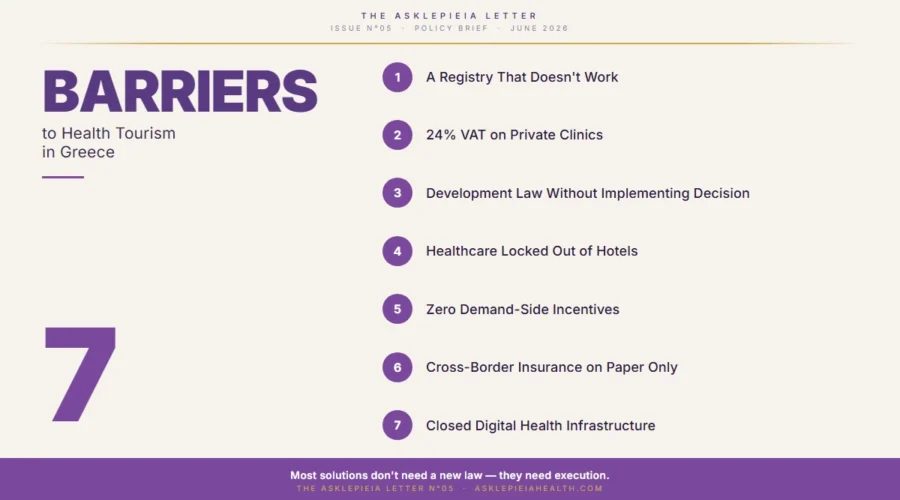
What’s missing, however, are seven specific state-level gaps that, if closed, can unlock Greece’s profile as an international health destination.
This is not an accusation. It’s a diagnosis. And most importantly: the solutions exist. In most cases, they are already written into law — they just aren’t being executed.
Barrier 1: A Health Tourism Registry that doesn’t work
How does a foreign patient, insurer, or tour operator know which Greek providers are certified for medical tourism? Today, they don’t.
The Electronic Health Tourism Registry has been legislated three times: in 2013 (Law 4179/2013), reformulated in 2014 (Law 4276/2014, under EOT), and again in 2018 (Law 4582/2018, Article 21), which transferred it to EOPYY. On paper it exists — described as a “public electronic database” linked to the Ministries of Health and Tourism.
In practice: no aggregate number of registered providers is published. There is no mandatory participation. It does not function as a trust tool for international patients.
Three laws. Three agencies. Twelve years — and the foreign patient still has nowhere to look.
Comparison: Turkey has the HealthTürkiye portal — publicly accessible, listing all providers certified by the Ministry of Health, 52 of them JCI-accredited. A foreign patient or insurer goes in, sees the options, and chooses.
How we overcome it: Activate the existing registry as a public, internationally accessible tool with quality criteria based on international accreditation standards. No new law needed — we already have three. Execution.
Barrier 2: VAT that penalizes clinical care
There is a widespread misconception here — and few people realize how much it costs.
The common assumption is that “medical services are VAT-exempt.” This is only partially true. Doctors’ fees and hospitalization costs at public and non-profit providers are exempt. But hospitalization fees at private for-profit clinics — exactly where the international patient is treated — are subject to 24% VAT (POL.1100/2010, now Article 27 of Law 5144/2024; the exemption under Article 132 of the VAT Directive is limited to entities “without the aim of making a profit on a systematic basis”).
In practice: a foreign patient coming to Greece for a procedure at a private clinic pays 24% VAT on top of the hospitalization cost. This is not theoretical — private clinics have been lobbying since 2019for a reduction “from 24% to 6%.”
And it’s not just clinical care. Aesthetic and wellness services — one of the largest segments of medical tourism — are also subject to 24% VAT (ECJ C-91/12). Two major market segments, the same pricing barrier.
Comparison: Turkey, as a non-EU country, fully exempts medical tourism services for foreign patients from KDV (treated as a “service export”). Greece, bound by the EU framework, cannot replicate this — but it can move within the available margins.
How we overcome it: Two viable routes within the EU framework — a reduced rate for medical and wellness services to international patients, or a VAT refund mechanism for foreign patients, analogous to the tax-free scheme for goods.
Barrier 3: A Development Law that sits dormant for healthcare
Here, the truth is more interesting than the myth.
The myth says: “the Development Law excludes healthcare.” Wrong. Law 4887/2022, in its Annex, explicitly carves out from exclusion — meaning it keeps eligible — “investment plans for health tourism and medical tourism.” On paper, medical tourism qualifies for state support.
In practice? Article 129(18) of the same law states that the terms for accepting healthcare investment plans (NACE codes 86 and 87) shall be determined by a Joint Ministerial Decision. That JMD does not appear to have been issued. Four years later, no regime has ever been opened to accept medical tourism investment proposals.
Result: eligibility exists in the law, but it’s a dead letter. The investor has nowhere to file.
There is no better example of everything we’ve been saying in this series: the plan isn’t missing. Execution is. The law says “yes” — the JMD that would make it real was never written.
(Large projects above €20 million can go through the Strategic Investments framework under Law 4864/2021, which explicitly includes medical tourism. But the main route, the Development Law for mid-sized investments, remains closed.)
How we overcome it: Issue the JMD that the law itself has required for four years. No legislative change — one ministerial signature.
Barrier 4: Primary healthcare that doesn’t fit inside a hotel
Imagine a five-star hotel that wants to offer medical wellness — preventive medicine, regenerative services, medical monitoring. In the rest of Europe, this is routine. In Greece? A paradox.
Because the law already recognizes the principle — elsewhere. Article 22 of Law 4582/2018 states that within thalassotherapy and thermal tourism centers, a “medical office is mandatory,” and explicitly provides for the possibility of this being a full primary care unit. The state has already accepted the idea that a healthcare unit belongs inside a tourist facility. (With a telling detail: even this provision remains on paper — the implementing JMD does not appear to have been issued. The same pattern as the Development Law.)
But a standard 4- or 5-star hotel, without a recognized thermal spring, has no such provision at all. Ministerial Decision 216/2015 on hotel star classification, under “Other Services,” lists eight categories — none for health. The state recognized the principle for one category of tourist infrastructure, and stopped there.
Comparison: Across Europe, the model is institutionalized. In Italy, Law 323/2000 explicitly provides for thermal units “attached to hotels,” with a mandatory medical director. Hungary has a separate legal category — “gyógyszálloda,” literally “medical hotel.” The Czech Republic (Law 372/2011) recognizes spa towns as licensed healthcare providers, with coverage even under public insurance. In Germany, clinics like Buchinger Wilhelmi operate within a hospitality setting under insurance contracts. And Swiss Clinique La Prairie has combined clinic and five-star accommodation since 1931.
The pattern is consistent: everywhere there is a mechanism that allows it — a legal category for “medical hotels,” a certification that counts the presence of a physician, or a straightforward licensing pathway. In these countries it works. In Greece, even where the law provides for it, it remains on paper. According to a diaNEOsis study (2019), only 6.1% of Greek hotels — all 4- and 5-star properties — offer even minimal medical care.
How we overcome it: No new idea is needed — we need to execute a principle we have already recognized. Add a “Primary Healthcare Services” criterion to Ministerial Decision 216/2015, with licensing by the local Medical Association, extending to hotels what the law already provides for thermal centers. One amendment to a ministerial decision, and stalled investments are unlocked.
Barrier 5: Tax incentives that attract patients — which we don’t have
The previous barriers are about not blocking. This one is about actively attracting.
Are there targeted incentives that a country offers to bring in patients, not just reduce costs? In Greece, no.
Comparison — what Turkey does:
- 80% deduction on taxable revenues from medical tourism services (Law 7491 of 2023, increased from 50%)
- 50% subsidy on medical tourism agent commissions, up to $100,000/year
- Subsidies for incoming patients’ flights
In other words: Turkey pays to bring the patient to the provider’s door. Greece offers none of these tools. Greek providers compete without equivalent support.
How we overcome it: A demand-side incentive package — marketing subsidies for international outreach and intermediary commissions — tied to registration in the registry (which is why Barrier 1 matters so much).
Barrier 6: Cross-border insurance and bilateral agreements that stay on paper
Two different tools, one shared goal: who pays, and how does the patient get here.
Cross-border insurance. Directive 2011/24/EU allows Europeans to receive care in another member state with reimbursement from their home insurer. In Greece it was transposed via Law 4213/2013, with EOPYY as the National Contact Point. The problem: there is no infrastructure for direct contracting between Greek providers and foreign funds. The patient pays upfront and claims afterward — a burden that suppresses demand. (The Netherlands has operated extensive direct-contract networks with neighboring countries since 1976.)
Bilateral agreements. Beyond the EU, there are state-to-state agreements that direct patient flows. Greece has none for health tourism.
Comparison: Turkey, through state-owned USHAŞ, signs intergovernmental protocols — e.g., the Turkey-Georgia medical tourism protocol (December 2020) — and maintains a network of “health attachés” in target countries.
How we overcome it: A framework for direct contracting between certified providers and foreign funds, with EOPYY as organizer rather than relay point, plus a dedicated unit for bilateral agreements with target countries.
Barrier 7: Without digital health, there is no international health tourism
To compete internationally in health tourism, doctors and hotels are not enough. You need an infrastructure that isn’t visible to the naked eye: a medical IT market, innovative digital health services, secure data flows. This is the foundation on which every modern destination is built — and simultaneously part of the image a country projects as a serious player.
In practice: the international patient must be able to securely upload their medical file before the trip, the provider must be able to assess it, and the data must travel back afterward. Same for the Greek patient traveling within the country. Private players are already building such solutions — but they remain constrained as long as the open state infrastructure on which they would build is missing.
Why is it missing? Because the Greek model of digital health is closed: the public body develops applications itself rather than functioning as a neutral interoperability infrastructure. In practice, there is no open API on top of patient data. A startup that wants today to develop a service for that patient — secure record exchange, digital preparation before surgery, post-procedure monitoring — simply cannot. There is nowhere to stand. Private investment doesn’t flow, and the country loses both the infrastructure and its competitive advantage.
Comparison: In Belgium, the public e-health organization does not develop the software itself and holds no monopoly. It provides security, hosting, and interoperability — and lets the market build. And it is now a requirement: the EHDS Regulation (EU 2025/327) mandates open, interoperable architecture by 2027, binding private providers as well.
How we overcome it: Transform the public body into a provider of core services — security, hosting, interoperability — with open architecture and open APIs on top of which the private sector and startups build the services patients need, foreign and Greek alike. Digital health is not a cost; it’s infrastructure, national projection, and competitive advantage. Not a state that builds everything; a state that enables.
Seven barriers, one problem
These are not seven random things. They are the same structural gap — the absence of a national system for health tourism.
Together, they keep Greece at €30.6 million in revenues from health-related travel in 2024 (Bank of Greece, 8/5/2025). And most worryingly: we are declining. €61.7 million in 2022, €37 million in 2023, €30.6 million in 2024 — a second consecutive year of decline. The gap with Turkey (1.5 million patients, ~€2.8 billion) is widening.
The providers exist. The hotels exist. The foreign patients would come. What’s missing is the institutional framework and coordinated execution. The plan exists; the problem is not a study — it’s execution.
What comes next in this series
In the upcoming issues of THE ASKLEPIEIA LETTER we will analyze each of the 7 barriers in depth: how things work today, how they work elsewhere, what can change — and who can change it.
I invite dialogue from healthcare and hospitality entrepreneurs, legal and tax professionals, and public sector executives — to share experiences and discuss implementation specifics.
Asklepieia proposes the framework. The state has the tools. Together we can unlock the doors.
Seven doors, one key
Seven barriers. Seven solutions — most of them fit on the same pages of the Government Gazette.
We don’t need new laws — we need to execute the existing ones. We don’t need new capital — we need better use of what we have. We don’t need a new vision — we need to execute the vision we already have.
George Kakoulidis
CEO & Founder, Asklepieia Health Cluster
This article is for informational purposes only and does not constitute medical advice. Treatment options, clinical outcomes, costs, eligibility, and legal or regulatory requirements may vary by individual circumstance and by jurisdiction. Always consult a qualified physician — and, where relevant, a qualified legal advisor — before making decisions about diagnosis, treatment, or care arrangements.